

Lord Vallier.
A man who followed no instruction but his own.
Born into English nobility. He left it before it could define him.
At seventeen, he departed his family estate without announcement. For several years, he travelled the continent with a circus troupe — not as a spectator, but as a trapeze artist. He described this period later, without irony: “It was the only profession I had yet found that required both complete precision and complete trust in another human being. I was not aware, at the time, that I was looking for both.”

What separates the objects that survive from the objects that are forgotten?
He studied art and philosophy at one of England's great universities, where he encountered the question that would define the rest of his life. His answer was not fame. Not scale. It was intention.
Salons, not boutiques.
Throughout his adult life, Lord Vallier operated several private hotels across Switzerland, France, and Austria. Not known for their facilities — known for their rooms, each furnished as a private interior, and for their guests: intellectuals, artists, collectors. People who had chosen their lives rather than inherited them. The watches he wore, and occasionally showed to guests, were never the subject of conversation. They were the beginning of one.
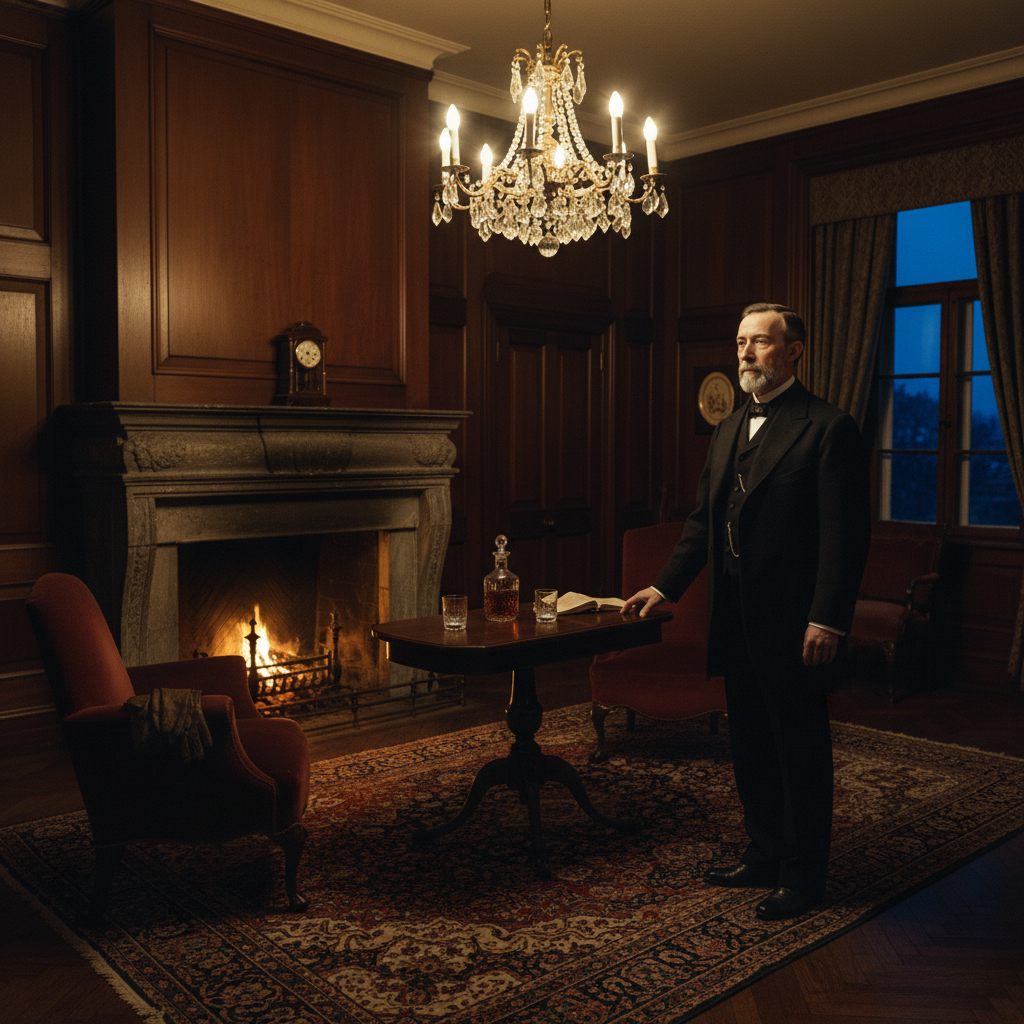
He never used the word “watch.” He used the word souvenir.
Not a keepsake. Not a memento. A remembrance — an act of holding something in mind. A mechanical movement, to him, was proof that the human mind, at sufficient concentration, could construct something that would outlast it. Not immortality. Something more modest, and more true: the possibility of continuation.
The only sorrow that accompanied him.
The marriage
Lord Vallier could not have children of his own. In his later years he met a woman he described, in private correspondence, as having the character of an object of genuine craftsmanship: “made under difficulty, refined by it, and more beautiful for what had been required of her.”
The child
She came to him already carrying a child from a violent and unspoken past. He married her immediately. He accepted the child without qualification.
The continuation
After Lord Vallier's death, the son continued the maison. He changed nothing of its philosophy, its scale, or its refusal to explain itself to those who did not already understand.
The story of Lord Vallier is a founding mythology — a literary and artistic framing for the values the maison holds. Vallier & Cie. does not claim official historical lineage, royal patronage, or state-certified heritage. The maison's authenticity rests entirely on the standard of its objects. As Lord Vallier would have preferred.